
Investigaytors
The Investigaytors are a community-based research mentorship program conducting research on queer and trans health, by and for the community.
Investigaytors Project Archive
*
Investigaytors Project Archive *
Investigaytors 2024
Our Bodies, Our Health
Our Bodies, Our Health is a national study exploring 2S/LGBTQIA+ communities’ sexual and reproductive health. Some of the topics include sexual behaviour and health, sex and pleasure, family planning, abortion, gender-affirming care, cancer prevention, and sexual violence. The survey aims to address barriers and gaps our community faces when it comes to sexual and reproductive care. Read more about the survey here.
In 2024, the Investigaytors began a three-year journey with the Our Bodies, Our Health survey. During this program cycle, our team assisted in developing the survey. We developed a focus group guide and held community consultations to determine what sexual and reproductive health topics were important to local queer and trans folks. We analyzed the consultation transcripts to come up with common themes, which we then used to develop survey questions. These survey questions were then adopted into the national survey.
Our Bodies, Our Health launched in May 2025 and ran both online and in person at pride festivals across Canada. The Alberta Investigaytors team helped with in-person data collection at Saskatoon, Lethbridge, Edmonton, and Calgary Pride.
In the coming year, our team will analyze the Alberta-specific data, and in 2027, we will share our findings back with the community in fun and exciting ways. Follow along to see what comes out of this project!

Investigaytors 2023
The Sex of It All!
In the 2023-2024 cohort, the Investigaytors took a deep dive into all things sex positivity. From late March to early April 2024, the team ran an original survey among 2S/LGBTQIA+ Albertans to better understand how sex positivity impacts sexual health knowledge and resource access, as well as connection with community.
The team created two mini-reports from the research.
The first mini-report looks at factors contributing to sex positivity among 2S/LGBTQIA+ folks in Alberta and explores a variety of themes such as sexual safety (physical, emotional, and psychological), communication, consent, and self-care.
The second mini-report provides suggestions to improve sexual health care for 2S/LGBTQIA+ folks in Alberta. It includes tips for providers on creating affirming clinic spaces, suggestions on streamlining care access, and a discussion on the overlap of sexual health care and gender affirming care.
Investigaytors 2022
Our Health Study
Our Health 2022 was a Canada-wide survey run by the Community-Based Research Centre (CBRC). The survey was open to all 2S/LGBTQIA+ people in Canada. The survey ran online from April to September 2022, and a total of 4,044 people completed it.
Our Health asked a wide range of questions about 2S/LGBTQIA+ health and well-being, but was particularly focused on experiences of COVID-19 and chronic health. Data collection was run by the Community-Based Research Centre, and Investigaytor cohorts across the country were invited to assist in quantitative data analysis.
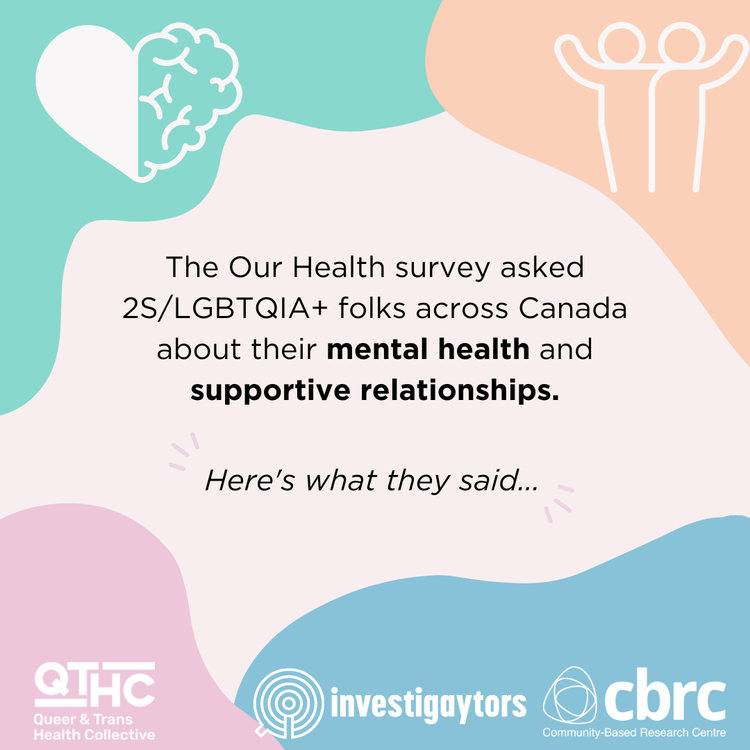
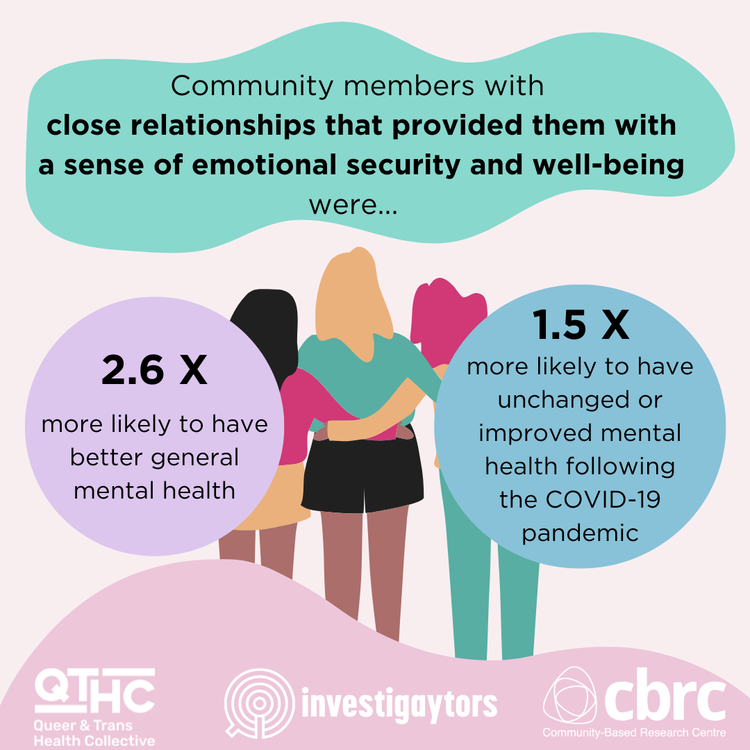
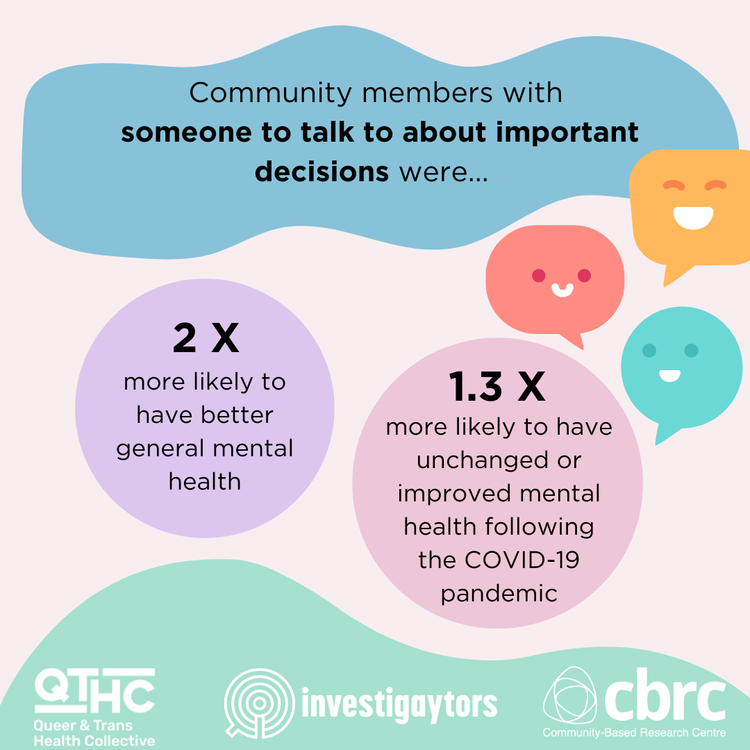
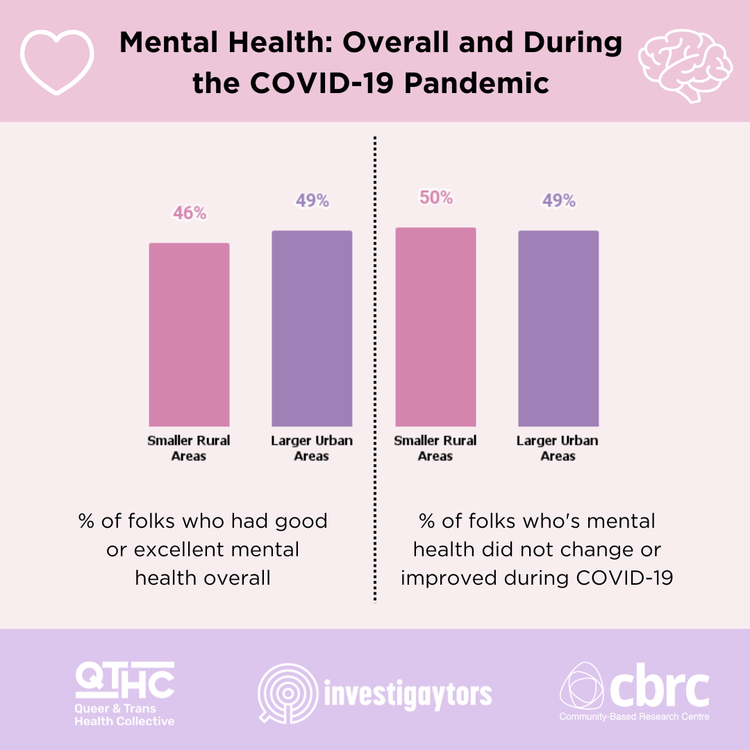
The Alberta Investigaytors were interested in looking at the impact of supportive relationships on mental health, both in general and during the pandemic. Overall, our team found that supportive relationships were an important protective factor that improved mental health outcomes. Check out our analysis below!
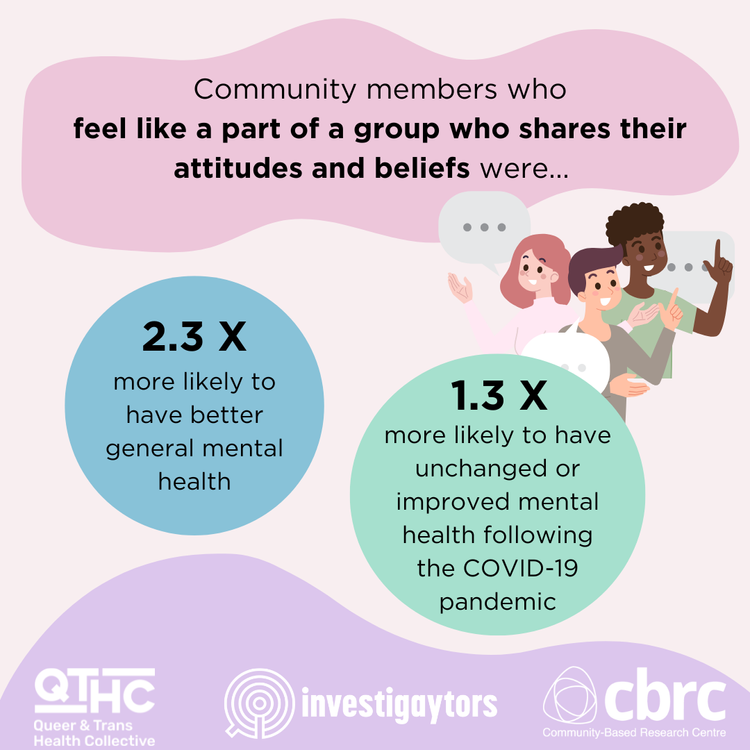
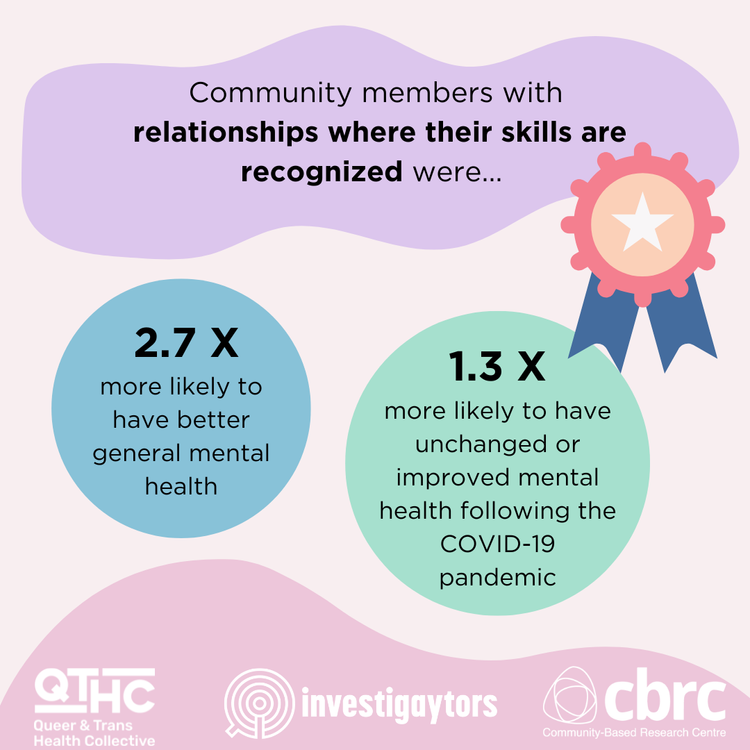
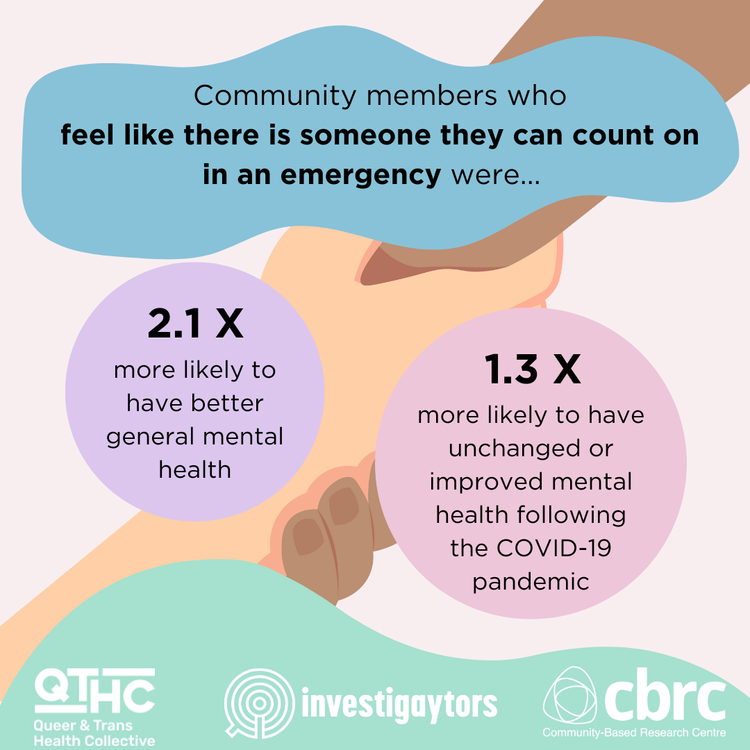
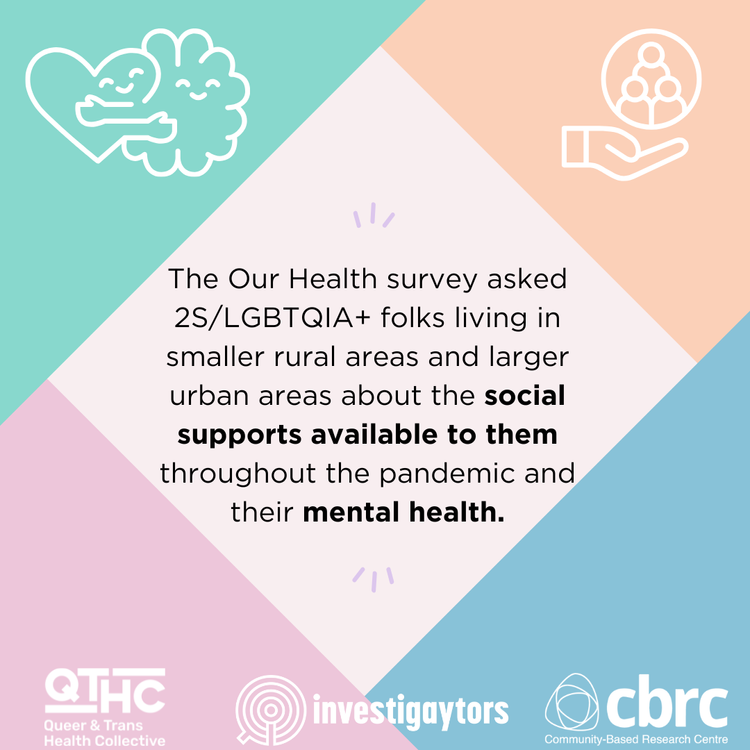
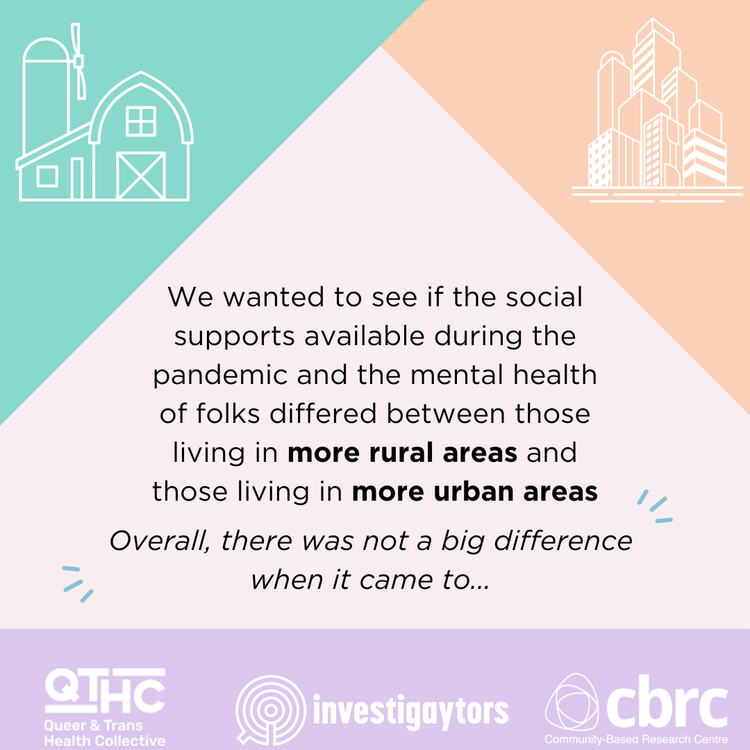
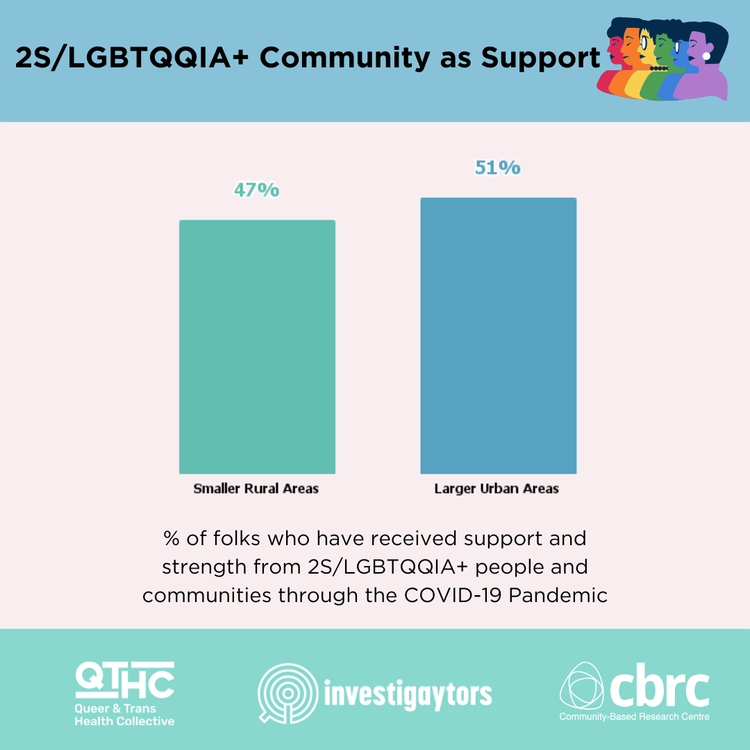
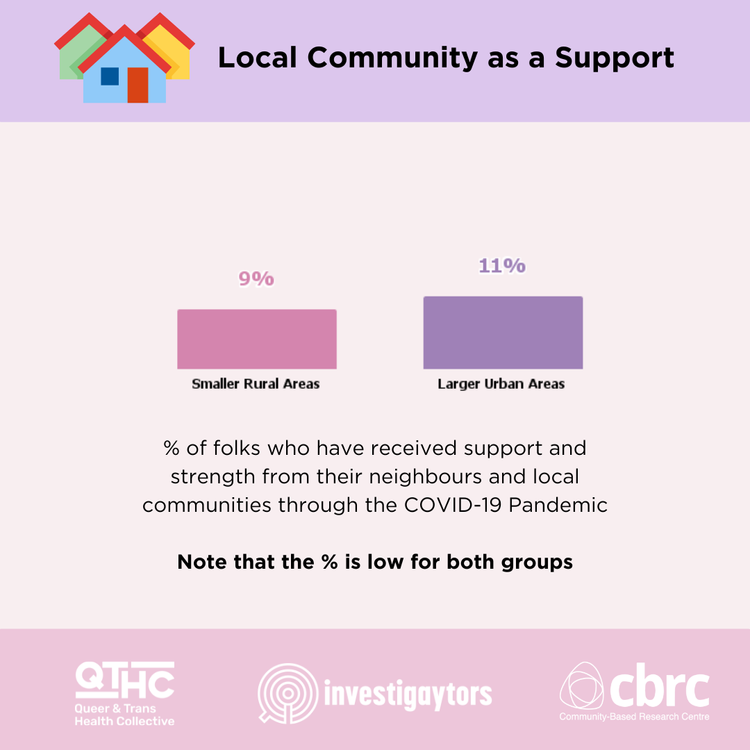
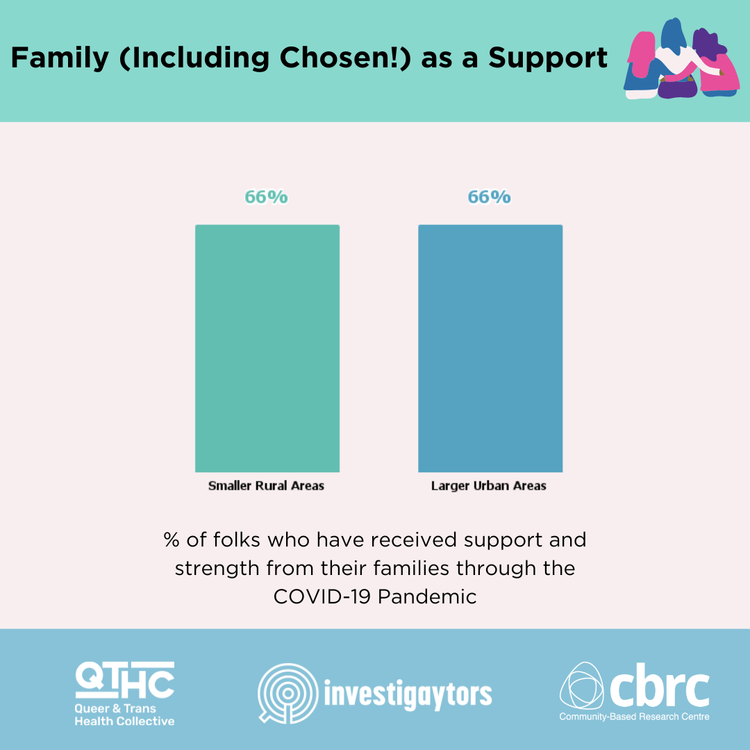
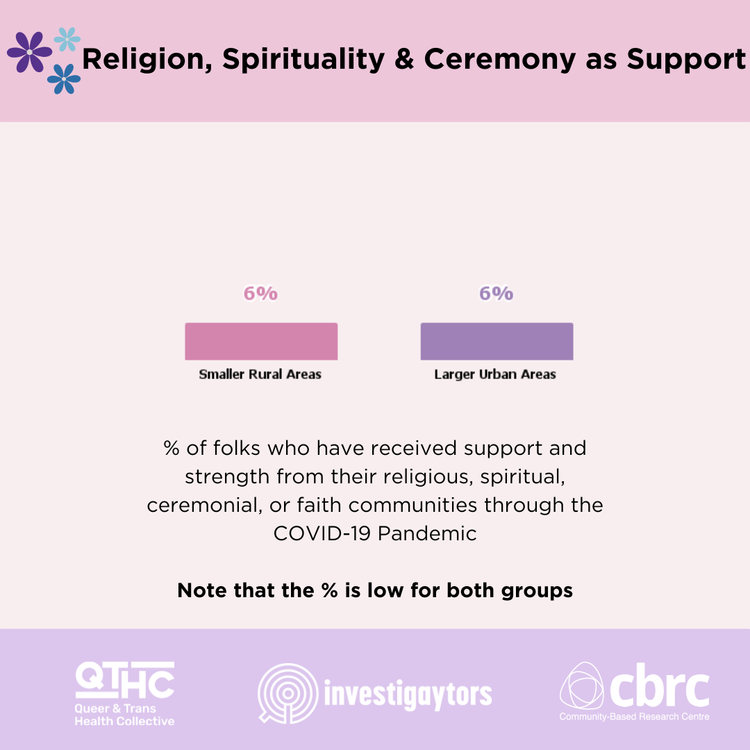
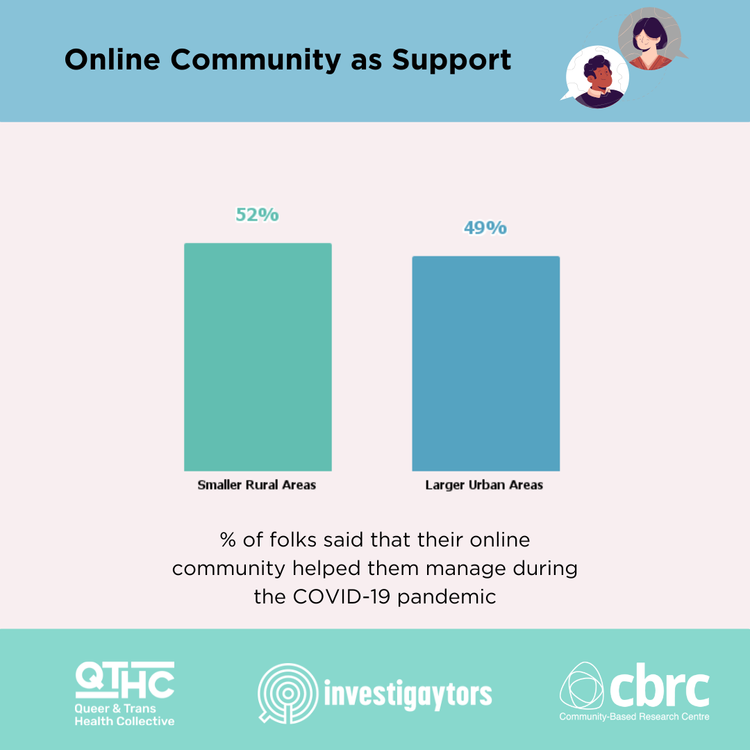
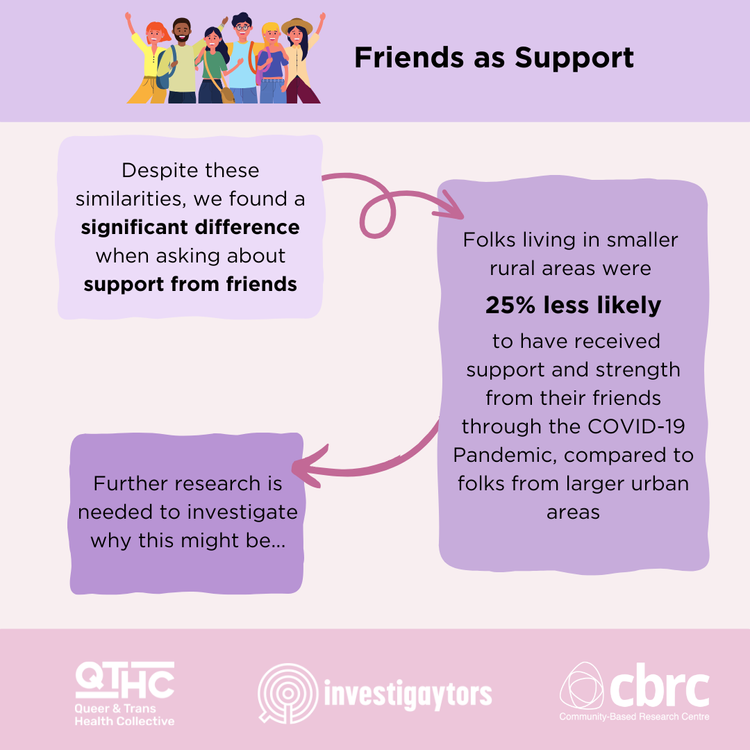
Our team also looked at the social supports available to 2S/LGBTQIA+ folks in both smaller rural and larger urban settings during COVID-19.
Our team was surprised to find that there were actually a lot of similarities in the supports being accessed in both rural and urban environments, even though there are typically fewer resources available in rural communities. While the survey data doesn’t allow us to say for sure, one of our theories is that since many folks were accessing online resources during the pandemic, some of the barriers faced by rural 2S/LGBTQIA+ folks may have been reduced.
Click through our analysis below to learn more!
Queer Health Study
It’s tough finding a healthcare provider (HCP) who gets it.
Finding a HCP who is understanding and affirming of 2S/LGBTQIA+ experiences is a daunting task. For the 2021-22 Investigaytors cohort, they wanted to understand why.
The group researched community experiences around 2S/LGBTQIA+ affirming healthcare in Alberta to uncover the current state of affirming healthcare in our province. QUEER Health: Questioning Use and Experience Engaging in and Receiving Healthcare in Alberta reflects this curiosity in the form of community-based research.
Investigaytors 2021
This research project asks the question “How are 2S/LGBTQIA+ individuals in Alberta identifying and accessing healthcare, and what aspects of their experiences help facilitate positive interactions?” Through connecting with community members across the province via online surveys, focus groups, and interviews, Investigaytors participants looked at the factors at play that give queer and trans folks positive healthcare experiences, and specific places where HCPs can improve their interactions queer and trans patients.

Download these helpful Tip Sheets
You can also watch the presentation of the research project and its findings below:
Reflections on Gender During the Pandemic
In 2020, Investigaytors looked a little different as we adapted to COVID-19. Not only did we run all of our weekly sessions online, but the pandemic also shaped our research.
This was the first time our Alberta-based team of Investigaytors conducted qualitative research, and it was a really rewarding journey to work through the entire research process, from deciding what we wanted to research, to interviewing members of our community, to analyzing and presenting our findings.
Download our zine, which presents our research project, “Reflections on Gender Identity and Expression During the COVID-19 Pandemic” - we are so excited to share it with you!
Investigaytors 2020

We also had an Investigaytor delve into the CBRC’s Sex Now survey data, exploring how actual or perceived judgment by healthcare providers may be impacting healthcare access for trans and non-binary folks. Click here to see this project!
We would like to thank our generous funders, the Public Health Agency of Canada and the Edmonton Community Foundation, who made this research possible. We also want to thank Joshua Armstrong, the Research Sub-Committee of the QTHC Board of Directors, Ben Klassen, Nathan Lachowski, and Harlan Pruden for their invaluable support, guidance, and wisdom throughout these projects. We are beyond grateful to the community members who trusted in us to hold and amplify their stories. Thank you.
Investigaytors 2019
Analysis of Sex Now
Over Spring and Summer 2019, a group of Edmonton queer and trans folk met weekly to learn about community-based research and queer and trans health. At the end of their training, participants developed their own research questions and conducted their own data analysis using Alberta Sex Now data. Below, you’ll find the results of their analysis in the form of research posters and brief interviews.
-
What topic did you research?
I researched mental health in Edmonton’s queer and trans community.
What made you interested in this topic?
I’m passionate about mental health and wanted to see how these issues were experienced in the queer community.
What did you discover through your research?
I discovered that a significant portion of the community is suffering from depression and anxiety, just over a quarter of Edmonton’s survey respondents. In particular, I discovered that trans and non-binary folks have unique mental health needs and are well-versed in such issues, both as recipients of services and as peer support resources.
What implications does this have for our community?
The results shed light on some of the unique mental health needs of subgroups within Edmonton’s queer and trans population, which I hope will lead to greater access to appropriate services and incorporation of trans and non-binary people in program planning.
Based on what you learned, what would you like to explore further/next?
I would like to continue to explore some of these differences in the mental health needs of subgroups within Edmonton’s community. After learning how to analyze the Sex Now survey data, it would be nice to take into account more variables and further our understanding of our community’s needs.
-
What topic did you research?
My study looked at which demographic variables (e.g. gender identity, sexual orientation, financial stability, education, race, hiv status, etc.) predicted having had sex with a trans or non-binary person in the past six months.
What made you interested in this topic?
When I was considering joining Investigaytors, I realized I had a lot of anxiety about interacting with cis, gay men. This was primarily due to rude comments cis, gay men had made to me over the years, mostly sexualizing me and my (trans) body, even when the context in which we were meeting was not sexual. Most of the comments framed my body as though it was superficially attractive, but that my genitals were disgusting to them. I was curious about whether experiencing marginalization made people more likely to sleep with trans people and about whether we can think about sexual relationships as being a marker of trans inclusion in our communities.
What did you discover through your research?
I discovered that trans people, bisexual/pansexual/queer (but not gay) people, gay men who had had sex with a woman in the last six months, and men who had seen sex workers in the last six months were more likely to have had sex with a trans person in the last six months. Gay men and men with higher education levels were less likely to have had sex with a trans person recently. This last result was driven by an interesting, though tangential finding: non-monosexual guys (guys who were bisexual, pansexual, or queer but did not identify as gay) were more likely than gay guys to have lower education levels. Race, immigration status, and financial stability were not related to sexual relationships with trans people.
What implications does this have for our community?
These findings suggest that if having sex with trans people is an indicator of trans inclusion, then the cis, gay men community has some work to do, with gay men being nine times less likely to have had sex with a trans person recently when compared to non-monosexual guys. I was surprised to see that, besides bisexuality and transness, experiencing other kinds of marginalization was not associated with having had sex with a trans person recently. Maybe this means we aren’t drawing on folks’ empathy when we’re educating about trans inclusion, and efforts could be made to draw linkages between, say, the experience of being marginalized due to racialization and the experience of being marginalized due to transgender status.
Based on what you learned, what would you like to explore further/next?
I’m particularly curious in the finding that bisexual men were less educated than gay men in Alberta. I am interested in looking at the ways non-monosexual queer guys are marginalized within the men’s queer community and whether that has an impact on their physical, mental, and social health.
-
What topic did you research?
I looked at what impacts knowledge of U=U (Undetectable=Untransmittable) might be having on sexual behaviour, especially the sexual behaviour of folks who are HIV negative.
What made you interested in this topic?
The U=U campaign has been really prominent in our community, and I wanted to get a sense of what impact it might be having. U=U has a lot of potential to reduce stigma surrounding HIV, and it’s also really significant in terms of Treatment as Prevention strategies. But I’ve heard folks saying that it hasn’t actually done much in terms of reducing stigma, so I was curious what the numbers might show us.
What did you discover through your research?
I discovered that there does appear to be a relationship between U=U knowledge and certain sexual behaviours. The two that really stood out to me were that folks who knew U=U were significantly more likely to have had sex with a man of an opposite HIV status in the last six months, and to have had sex with someone who was undetectable.
What implications does this have for our community?
This is just a little snapshot of the potential impacts of U=U, but it does seem to suggest that the campaign might be having some sort of measurable impact, which is really cool!
Based on what you learned, what would you like to explore further/next?
There’s some work around U=U starting to happen at the national level, looking at similar questions about sexual behaviour of HIV-negative folks, but also asking questions about what impacts U=U might be having on the mental health of people who are positive, and considering if all members of our community have had equal access to U=U knowledge. It’s super interesting work that I’m excited to be a part of, and I am really looking forward to having an even deeper understanding of how U=U might be playing out in our everyday lives.
-
What topic did you research?
We looked at the connection between identity (gender, age, race) and levels of satisfaction with connection to the community.
What made you interested in this topic?
We initially began our research considering how a connection to community might be related to things like sexual health literacy and knowledge of U=U. This led us to consider if members of the 2S/LGBTQIA+ community are satisfied with their community connections in the first place. As we thought through this seemingly basic topic, it then began raising additional important questions about who may perceive community differently or have different experiences within the community, which led us to disaggregate the data based on some axis of identity (racialized identity, age, gender identity).
What did you discover through your research?
Overall, we found that respondents who may be further marginalized than the majority of respondents tend to have different levels of satisfaction with the community when compared to average respondents.
Respondents who identified as BIPOC (Black, Indigenous, People of Colour) had a significantly lower level of satisfaction with the 2S/LGBTQIA+ community. While 58% of white respondents were satisfied with the community, only 47% of BIPOC respondents felt the same. When looking at BIPOC respondents by age, those respondents born before the AIDS crisis noted having a higher level of satisfaction with the community (63%) when compared to those born after the AIDS crisis (46%).
One interesting finding was that respondents who identified as trans expressed similar levels of satisfaction with their connection to the community as all respondents. This contradicted our hypothesis that trans community members would have a higher level of dissatisfaction.
What implications does this have for our community?
This research is especially relevant in the Edmonton context as our 2S/LBTQIA+ community wrestles with feelings of exclusion among some community members, as well as broader community understandings of what pride means for Edmonton. What is apparent is that a segment of the community — our BIPOC community members — are not satisfied with their own connections to the community, and it appears to be especially true among younger community members.
Based on what you learned, what would you like to explore further/next?
There is a need to further contextualize how respondents perceive “community” and specifically what factors affect satisfaction relative to that understanding. There is also an opportunity to not just understand what people think community is, but to provide a venue for them to define it themselves and for community organizations to respond accordingly to increase satisfaction.
Questions?
Contact the Study Director, Finn St Dennis (he/they) at finn.st.dennis@ourhealthyeg.ca.
This research project (#00151098) has been approved on ethical grounds by the University of Alberta Research Ethics Board. Any questions regarding your rights as a participant may be addressed to the Board at reoffice@ualberta.ca.

Investigaytors is a community-based research mentorship program conducting research on queer and trans health, by and for the community. Learn more about the Investigaytors here.

Community-Based Research Centre (CBRC) promotes the health of people of diverse sexualities and genders through research and intervention development.

Queer & Trans Health Collective (QTHC) is a grassroots health organization run by and for queer the trans community with a vision for all queer and trans community members to have equitable opportunity to experience positive health and well-being.